Materi :
Daily Life, Time, and Data Management
Sub Materi :
1. The Chronology of Days
2. The Mechanics of Time
3. Lexicon of Daily Activities
4. Syntax and Temporal Sequencing
5. Professional Data Analysis (Case Study)
Pengantar Materi
Effective daily life, time, and data management involve structuring routines, prioritizing tasks, and organizing digital or physical information to boost productivity and reduce stress. Key strategies include using calendars, setting SMART goals, applying the Pomodoro technique, and adopting digital tools for consistent, long-term organization and goal achievement.
The Chronology of Days
This chapter establishes the fundamental vocabulary for time management by mastering the weekly cycle.
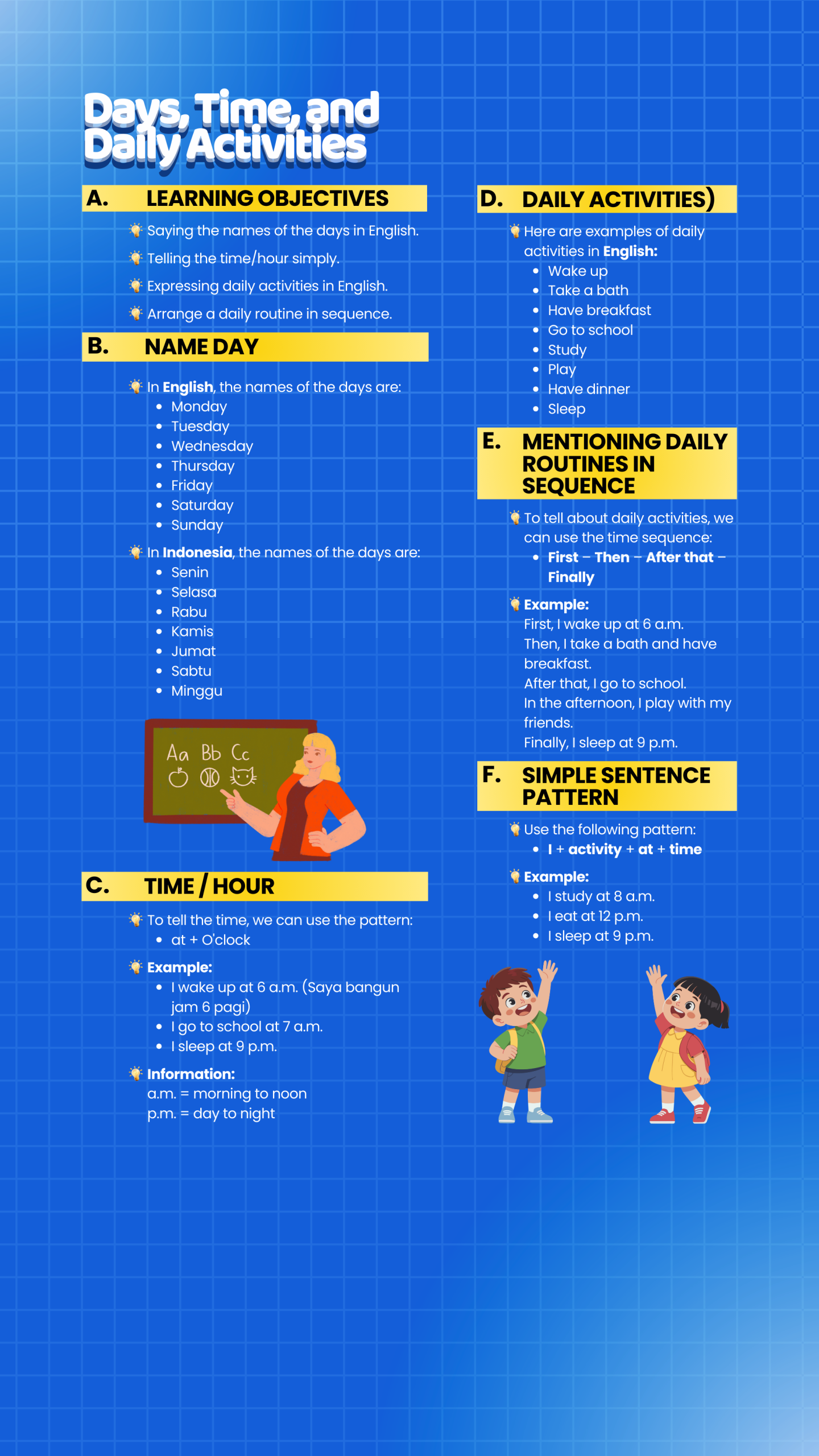
1 Learning Objectives
- Mastering the pronunciation and spelling of the seven days of the week.
- Learning to express time and specific hours simply.
- Developing the ability to describe daily routines in English.
- Organizing personal routines into a logical sequence.
2 Weekly Nomenclature
Understanding the transition between the English and Indonesian naming systems:
- Monday (Senin)
- Tuesday (Selasa)
- Wednesday (Rabu)
- Thursday (Kamis)
- Friday (Jumat)
- Saturday (Sabtu)
- Sunday (Minggu)
The Mechanics of Time
This chapter focuses on how to communicate specific moments throughout the day using standard notation.
.1 Telling the Hour
To indicate a specific time, the preposition “at” is used before the numerical hour.
- Grammar Pattern: at + O’clock
- Practical Examples: * “I wake up at 6 a.m.”
- “I go to school at 7 a.m.”
- “I sleep at 9 p.m.”
2 Meridiem Understanding (a.m. vs. p.m.)
In the 12-hour clock system, markers are used to distinguish morning from night:
- a.m. (Ante Meridiem): Used for the period from morning until noon.
- p.m. (Post Meridiem): Used for the period from midday/afternoon until night.
Lexicon of Daily Activities
Building a vocabulary of verbs that represent common human routines.
Essential Routine Verbs
- Self-Care: Wake up, take a bath.
- Nutrition: Have breakfast, have dinner, eat at 12 p.m..
- Education: Go to school, study.
- Leisure & Rest: Play, sleep.
Syntax and Temporal Sequencing
This chapter explains how to combine vocabulary and time into structured sentences and stories.
1 Simple Sentence Construction
The basic formula for describing a habit involves the subject, the action, and the time:
- Structure: I + activity + at + time.
- Application: “I study at 8 a.m.”.
2 Narrative Flow (Connectors)
To tell a story or describe a full daily routine, we use specific transition words to show the sequence of events:
- First: Introduces the initial activity (e.g., waking up).
- Then: Moves to the next step (e.g., bathing).
- After that: Describes subsequent actions (e.g., going to school).
- Finally: Marks the conclusion of the routine (e.g., sleeping).
Professional Data Analysis (Case Study)
This chapter applies mathematical logic to real-world data tracking within a professional environment.
1 Production Growth Monitoring
Employees in industrial sectors, such as textiles, often track performance increases over specific periods.
- Scenario: A staff member named Mita tracks five periods of production growth.
- Recorded Data: 4%, 9%, 7%, and 5%.
2 Statistical Correlation: Mean and Median
The analysis of professional data often requires finding a balance between different statistical measures:
- The Challenge: Finding the 5th data point (x) where the Arithmetic Mean equals the Median.
- Statistical Range: Through algebraic calculation, it is determined that the possible value for the 5th period falls within the range of 0% to 10%.
Simpulan Materi
Latihan Soal
Soal Pilihan Ganda
A researcher observes a student’s daily routine journal that records activities with exact time expressions. The journal states: “I wake up at 6 a.m., I go to school at 7 a.m., I study at 4 p.m., and I sleep at 9 p.m.” However, the student is instructed to rewrite the routine using proper temporal connectors and correct chronological logic based on the mechanics of time and narrative flow. Which rewritten version best represents a logically ordered and grammatically accurate daily routine according to the module’s rules of sequencing and time expression?
A. First, I wake up at 6 a.m. Then, I go to school at 7 a.m. After that, I study at 4 p.m. Finally, I sleep at 9 p.m.
B. Then, I wake up at 6 a.m. Finally, I go to school at 7 a.m. First, I study at 4 p.m. After that, I sleep at 9 p.m.
C. After that, I wake up at 6 a.m. First, I sleep at 9 p.m. Then, I go to school at 7 a.m. Finally, I study at 4 p.m.
D. Finally, I wake up at 6 a.m. Then, I study at 4 p.m. First, I go to school at 7 a.m. After that, I sleep at 9 p.m.
E. First, I sleep at 9 p.m. Then, I wake up at 6 a.m. After that, I go to school at 7 a.m. Finally, I study at 4 p.m.
A school conducts a language experiment where students must convert a 24-hour schedule into a correct 12-hour clock system using a.m. and p.m. notation. One student writes the following schedule: wake up (05:30), have lunch (12:00), study (15:00), and sleep (21:00). The teacher explains that correct meridiem usage must reflect morning, noon, afternoon, and night periods properly. Which option shows the most accurate transformation of the schedule based on standard time mechanics?
A. 5:30 p.m., 12:00 a.m., 3:00 a.m., 9:00 a.m.
B. 5:30 a.m., 12:00 p.m., 3:00 p.m., 9:00 p.m.
C. 5:30 a.m., 12:00 a.m., 3:00 p.m., 9:00 a.m.
D. 5:30 p.m., 12:00 p.m., 3:00 a.m., 9:00 p.m.
E. 5:30 a.m., 12:00 p.m., 3:00 a.m., 9:00 p.m.
In a literacy study about daily routines, students are asked to construct sentences using the correct grammar pattern “Subject + Activity + at + Time.” A student produces several sentences:
(1) I am study at 8 a.m.
(2) I study at 8 a.m.
(3) I study on 8 a.m.
(4) I go to school at 7 a.m.
The evaluator states that only sentences that strictly follow the module’s syntactic rule and correct preposition usage are acceptable as valid routine expressions. Which combination of sentences meets the required grammatical and structural accuracy?
A. (1) and (3)
B. (2) and (4)
C. (1) and (2)
D. (2) and (3)
E. (3) and (4)
A curriculum developer compares English and Indonesian weekly nomenclature to test conceptual understanding of time cycles. A student claims that the weekly sequence in English can be logically aligned with Indonesian naming when arranged from the first school day to the last rest day. If the logical cycle begins with Monday and ends with Sunday, which sequence correctly represents a complete and properly ordered weekly cycle?
A. Monday – Wednesday – Tuesday – Friday – Sunday – Saturday – Thursday
B. Sunday – Monday – Tuesday – Wednesday – Thursday – Friday – Saturday
C. Monday – Tuesday – Wednesday – Thursday – Friday – Saturday – Sunday
D. Tuesday – Monday – Wednesday – Thursday – Sunday – Friday – Saturday
E. Wednesday – Thursday – Friday – Saturday – Sunday – Monday – Tuesday
In a data management case study, Mita records production growth over five periods: 4%, 9%, 7%, 5%, and x. A supervisor states that the mean and median must be equal to maintain production stability. If the values are arranged logically and the median represents the middle value of the ordered data, which statement best describes the possible behavior of x so that the balance between mean and median can still occur?
A. x must always be greater than 9%
B. x must always be equal to 7% only
C. x must be within a reasonable range that does not shift the central value drastically
D. x must be less than 0% to balance the mean
E. x must be the largest value in the dataset
Soal Essay
A student writes a full daily routine paragraph but mixes time expressions and connectors incorrectly: “I wake up at 6 a.m. After that I sleep at 9 p.m. Then I go to school at 7 a.m. Finally I study at 4 p.m.”
Discuss how the misuse of temporal sequencing affects the logical flow of the narrative and reconstruct a coherent routine paragraph that follows correct chronological order and proper time mechanics based on the module.A classroom observation shows that many students confuse the usage of “a.m.” and “p.m.” when describing daily activities. Suppose a learner writes: “I have dinner at 7 a.m. and go to school at 7 p.m.”
Evaluate the consistency of this schedule with real-life daily routines and rewrite the sentences so that they reflect logical time distribution and correct meridiem understanding.In a linguistic research project on routine verbs, students are asked to categorize activities into self-care, education, nutrition, and leisure. A diary lists the following actions: wake up, play games, study, have breakfast, sleep, and take a bath.
Explain how these activities can be reorganized into a structured daily narrative using appropriate connectors such as First, Then, After that, and Finally while maintaining grammatical accuracy.A school implements a time-management program where students must track their hourly activities and convert them into simple English sentences. One student records: 06.00 (wake up), 07.00 (go to school), 13.00 (have lunch), 21.00 (sleep).
Construct a logically sequenced paragraph using correct syntax, proper prepositions, and accurate 12-hour clock notation that reflects a disciplined daily routine.In a professional data monitoring scenario, an employee tracks productivity growth percentages across several periods and integrates the results into a report written in English. The report must include numerical interpretation and a descriptive routine structure of work activities throughout the day.
Formulate a detailed explanatory paragraph that combines daily routine expressions, correct time grammar, and logical sequencing while maintaining clarity and coherence suitable for a formal academic report.
Ingin Kembangkan Prestasi dan Kemampuanmu?
Yuk! Ikutan kompetisi online gratis dan terpercaya yang diselenggarakan oleh Lembaga Profesional dan terdaftar di SIMT PUSPRESNAS berikut ini:


Nama Lembaga |
Website |
Tingkat Kompetisi |
Bukti Kurasi |
|---|---|---|---|
Mengapa Harus Daftar Kompetisi Kami?
Pendaftaran Gratis
Pendaftaran Kompetisi dan Olimpiade GRATIS tanpa syarat apapun.
Apresiasi Juara Gratis
Apresiasi juara juga GRATIS tanpa perlu membayar klaim hingga ratusan ribu loh.
Beasiswa hingga Kuliah
Tersedia Beasiswa Khusus Alumni yang diberikan hingga kuliah loh!.
Pendukung Japres & SNBP
Piagam bisa digunakan untuk Jalur Prestasi, Beasiswa dan SNBP loh.
Sudah Ribuan Alumni
Sudah diikuti banyak alumni yang tersebar di seluruh Indonesia dan luar negeri.
Dikelola secara Syariah
Pengelolaan hadiah dan apresiasi dikelola secara terpisah dan sesuai syariah.
Bantuan Kurasi Prestasi
Tersedia layanan bantuan dan panduan kurasi prestasi peserta loh.
Legalitas Terjamin
Lembaga penyelenggara telah terdaftar di kementerian dan SIMT Kurasi.
Tunggu apalagi? Ingin kejar tiket SPMB Jalur Prestasi atau SNBP di tahun depan? segera gabung dan daftarkan dirimu sekarang juga!. Prestasi itu tidak ada yang instan loh! Mulai dan persiapkan versi terbaikmu mulai dari sekarang juga!.