
Materi :
Writing Skills
Sub Materi :
1. The Architecture of a Paragraph
2. Descriptive Writing – The Art of Imagery
3. Narrative Writing – Crafting the Story
4. Expository Writing – The Power of Information
Pengantar Materi
Writing is a multidimensional craft that requires a balance between creative expression and structural discipline. To move from basic communication to professional-level composition, one must understand how to manipulate different genres while ensuring that the underlying “connective tissue”—the paragraph—is robust and logical.
The Architecture of a Paragraph
The paragraph serves as the fundamental unit of any written work. A well-constructed paragraph acts as a mini-essay, containing a single, focused idea that is supported and expanded upon before transitioning to the next.
1 Structural Coherence and Unity
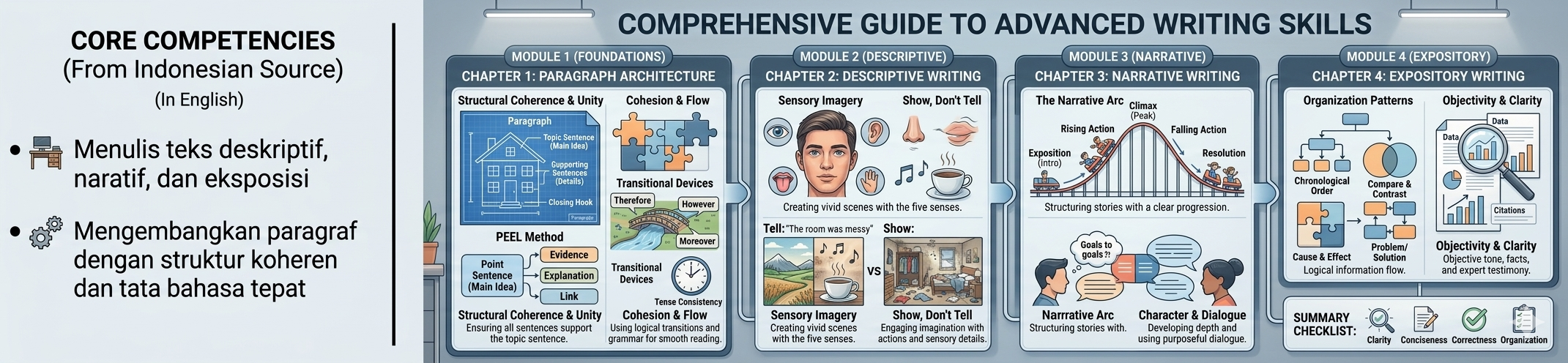
To achieve structural coherence, every sentence within a paragraph must relate back to the Topic Sentence. The topic sentence acts as a roadmap, telling the reader what to expect. Once the main idea is established, the writer must use Supporting Sentences to provide evidence, examples, or further explanation. A paragraph loses its impact when the writer “drifts” into unrelated topics. To prevent this, professional writers often utilize the PEEL Method (Point, Evidence, Explanation, Link), ensuring that each paragraph concludes by linking back to the overall thesis of the document.
2 The Mechanics of Cohesion
Cohesion refers to the “flow” of the writing. This is achieved through the strategic use of transitional devices and grammatical consistency. Long-form paragraphs often fail because they feel like a list of disconnected facts. By using additive transitions (e.g., moreover, furthermore), adversative transitions (e.g., nevertheless, on the contrary), and causal transitions (e.g., consequently, accordingly), a writer creates a logical chain that guides the reader effortlessly from one thought to the next. Furthermore, maintaining a consistent grammatical voice and point of view prevents the reader from becoming disoriented.
Descriptive Writing – The Art of Imagery
Descriptive writing is designed to create a vivid, immersive experience. It is not merely about listing the physical attributes of an object or person, but about capturing the atmosphere and emotional essence of a scene.
1 Sensory Integration and Spatial Order
Effective description goes beyond visual cues. By integrating the five senses—sight, sound, smell, taste, and touch—the writer builds a three-dimensional world. In longer descriptive passages, it is helpful to organize details in spatial order (e.g., moving from top to bottom, or from the background to the foreground). This systematic approach ensures the reader can mentally “map” the description without becoming overwhelmed by a chaotic jumble of adjectives.
2 The "Show, Don’t Tell" Philosophy
The hallmark of advanced descriptive writing is the ability to “show” the reader what is happening through actions and sensory details rather than “telling” them through flat statements. Instead of telling the reader that a room is “old and abandoned,” a writer might describe the “thick layer of grey dust coating the cracked mahogany frames” and the “stale, metallic scent of stagnant air.” This technique engages the reader’s imagination, making them an active participant in the story rather than a passive observer.
Narrative Writing – Crafting the Story
Narrative writing is the art of sequencing events to convey a message or explore a theme. Whether the story is a short anecdote or a complex novel, it must be anchored by a clear structure and compelling characters.
1 The Narrative Arc and Conflict
A story without conflict is merely a sequence of events. The Narrative Arc provides the necessary tension, beginning with the Exposition (setting the scene) and moving through the Rising Action (where the conflict intensifies). The Climax is the turning point where the tension reaches its peak, followed by the Falling Action and the Resolution. In longer narratives, subplots may be introduced to add depth, but they must ultimately serve the primary theme of the story.
2 Pacing and Dialogue
The primary goal of expository writing is to provide clarity. It is used to explain complex ideas, provide instructions, or analyze data without the interference of the writer’s personal bias.
Expository Writing – The Power of Information
The primary goal of expository writing is to provide clarity. It is used to explain complex ideas, provide instructions, or analyze data without the interference of the writer’s personal bias.
1 Logical Organization Patterns
Expository text must be organized in a way that best suits the information being presented. Common patterns include:
• Chronological Order: Used for historical accounts or “how-to” processes.
• Compare and Contrast: Used to analyze the relationship between two entities.
• Problem and Solution: Identifying a challenge and proposing a reasoned response.
• Cause and Effect: Tracing the origins of a phenomenon and its subsequent impacts.
2 Objectivity and Evidence-Based Analysis
Unlike descriptive or narrative styles, expository writing demands an objective tone. This means the writer must distance themselves from the subject matter, focusing on facts, statistics, and expert testimony. In long-form expository paragraphs, it is essential to define technical terms clearly and provide “real-world” applications for abstract concepts. This ensures that even the most complex technical information remains accessible to a general audience while maintaining its academic or professional integrity.
Simpulan Materi
Latihan Soal
Soal Pilihan Ganda
1. In the context of professional writing, the paragraph is described as the fundamental unit that ensures both coherence and unity. Consider a paragraph that begins with a strong topic sentence but gradually introduces loosely related anecdotes, statistical references, and stylistic digressions without clearly reconnecting them to the central claim. Based on the principles outlined in Chapter 1, particularly the discussion of structural coherence and the PEEL method, which of the following best explains the primary flaw in such a paragraph?
A. The paragraph overuses transitional devices, causing redundancy and stylistic monotony.
B. The paragraph lacks cohesion because it fails to maintain grammatical consistency throughout.
C. The paragraph violates unity by drifting away from the central idea established in the topic sentence.
D. The paragraph is ineffective because it does not include enough descriptive imagery to engage the reader.
E. The paragraph is structurally sound but lacks sufficient narrative pacing to sustain reader interest.
2. A writer attempts to improve the flow of a long analytical paragraph by inserting multiple transition words such as “moreover,” “however,” and “consequently.” However, the paragraph still feels disjointed and difficult to follow. Drawing on the explanation of cohesion in Chapter 1.2, which of the following is the most plausible reason for this issue?
A. The writer incorrectly applies the PEEL method, focusing too heavily on the “Link” component.
B. The transitions are used mechanically without establishing a genuine logical relationship between ideas.
C. The paragraph lacks sufficient sensory detail, which is necessary for effective cohesion.
D. The writer fails to include dialogue, which weakens the paragraph’s internal flow.
E. The paragraph relies too heavily on spatial organization rather than chronological order.
3. In Chapter 2, the distinction between “showing” and “telling” is emphasized as a defining feature of advanced descriptive writing. Suppose a student writes: “The marketplace was chaotic and overwhelming.” Which of the following revisions best demonstrates the “show, don’t tell” principle while maintaining clarity and sensory richness?
A. “The marketplace was very chaotic, busy, and overwhelming for everyone present.”
B. “The marketplace, which was chaotic, contained many different people and sounds.”
C. “Vendors shouted over one another as the sharp scent of spices mingled with sweat, and bodies pressed together in restless waves beneath the sweltering sun.”
D. “The marketplace was overwhelming because it had too many people and too much noise.”
E. “The chaotic marketplace created an overwhelming situation for visitors and sellers alike.”
4. A narrative text describes a sequence of events in which the protagonist faces increasing obstacles, culminating in a decisive confrontation that determines the outcome of the story. Following this moment, the tension gradually decreases, and the consequences of the confrontation are explored. Based on Chapter 3.1, which structural elements of the narrative arc are being described in this sequence?
A. Exposition → Rising Action → Climax → Falling Action
B. Rising Action → Climax → Falling Action → Resolution
C. Exposition → Conflict → Dialogue → Resolution
D. Rising Action → Subplot → Climax → Resolution
E. Exposition → Climax → Falling Action → Narrative Closure
5. Expository writing prioritizes clarity, objectivity, and logical organization. Imagine a writer is explaining the impact of technological advancements on communication patterns and chooses to structure the essay by first describing historical communication methods, then analyzing current technologies, and finally predicting future trends. According to Chapter 4.1, which organizational pattern does this approach most closely follow?
A. Compare and Contrast
B. Problem and Solution
C. Cause and Effect
D. Chronological Order
E. Thematic Fragmentation
Soal Essay
1. The effectiveness of a paragraph depends not only on the clarity of its topic sentence but also on the logical integration of supporting details and the strength of its concluding link. Drawing on the concepts of structural coherence, unity, and the PEEL method discussed in Chapter 1, critically evaluate how a poorly constructed paragraph can undermine the credibility of an entire piece of writing. In your response, provide a detailed analysis of potential errors and propose strategies to correct them.
2. Descriptive writing requires more than the accumulation of sensory details; it demands careful organization and purposeful selection of imagery. Using the concepts of sensory integration, spatial order, and the “show, don’t tell” philosophy from Chapter 2, analyze how a writer can transform a simple description into an immersive experience. Support your discussion with hypothetical examples and explain the cognitive effect on the reader.
3. Narrative writing is fundamentally driven by conflict and structure. Based on Chapter 3, examine how the manipulation of the narrative arc and pacing techniques can influence a reader’s emotional engagement with a story. In your answer, discuss how variations in sentence structure and dialogue contribute to the overall impact of a narrative.
4. Expository writing is often perceived as less engaging than narrative or descriptive writing due to its emphasis on objectivity. Drawing from Chapter 4, argue whether this perception is justified. In your response, evaluate how organizational patterns and evidence-based analysis can be used to make expository writing both informative and compelling.
5. Across all four writing modes—descriptive, narrative, expository, and structural paragraph construction—there exists a balance between creativity and discipline. Synthesize the key ideas from the text to discuss how mastering this balance contributes to professional-level writing. Provide a comprehensive argument that integrates techniques from multiple chapters and demonstrates their interdependence in producing effective written communication.
Ingin Kembangkan Prestasi dan Kemampuanmu?
Yuk! Ikutan kompetisi online gratis dan terpercaya yang diselenggarakan oleh Lembaga Profesional dan terdaftar di SIMT PUSPRESNAS berikut ini:


Nama Lembaga |
Website |
Tingkat Kompetisi |
Bukti Kurasi |
|---|---|---|---|
Mengapa Harus Daftar Kompetisi Kami?
Pendaftaran Gratis
Pendaftaran Kompetisi dan Olimpiade GRATIS tanpa syarat apapun.
Apresiasi Juara Gratis
Apresiasi juara juga GRATIS tanpa perlu membayar klaim hingga ratusan ribu loh.
Beasiswa hingga Kuliah
Tersedia Beasiswa Khusus Alumni yang diberikan hingga kuliah loh!.
Pendukung Japres & SNBP
Piagam bisa digunakan untuk Jalur Prestasi, Beasiswa dan SNBP loh.
Sudah Ribuan Alumni
Sudah diikuti banyak alumni yang tersebar di seluruh Indonesia dan luar negeri.
Dikelola secara Syariah
Pengelolaan hadiah dan apresiasi dikelola secara terpisah dan sesuai syariah.
Bantuan Kurasi Prestasi
Tersedia layanan bantuan dan panduan kurasi prestasi peserta loh.
Legalitas Terjamin
Lembaga penyelenggara telah terdaftar di kementerian dan SIMT Kurasi.
Tunggu apalagi? Ingin kejar tiket SPMB Jalur Prestasi atau SNBP di tahun depan? segera gabung dan daftarkan dirimu sekarang juga!. Prestasi itu tidak ada yang instan loh! Mulai dan persiapkan versi terbaikmu mulai dari sekarang juga!.